Big companies give their leaders a chief of staff: someone who walks in and says, "three things need you today." Everyone else gets a dashboard. Forty panels, waiting.
We run a fleet of products with one founder. So the fleet got a First Officer. You talk to it. It reports to you.
Dashboards wait to be read. A first officer reports.
Thirteen seconds
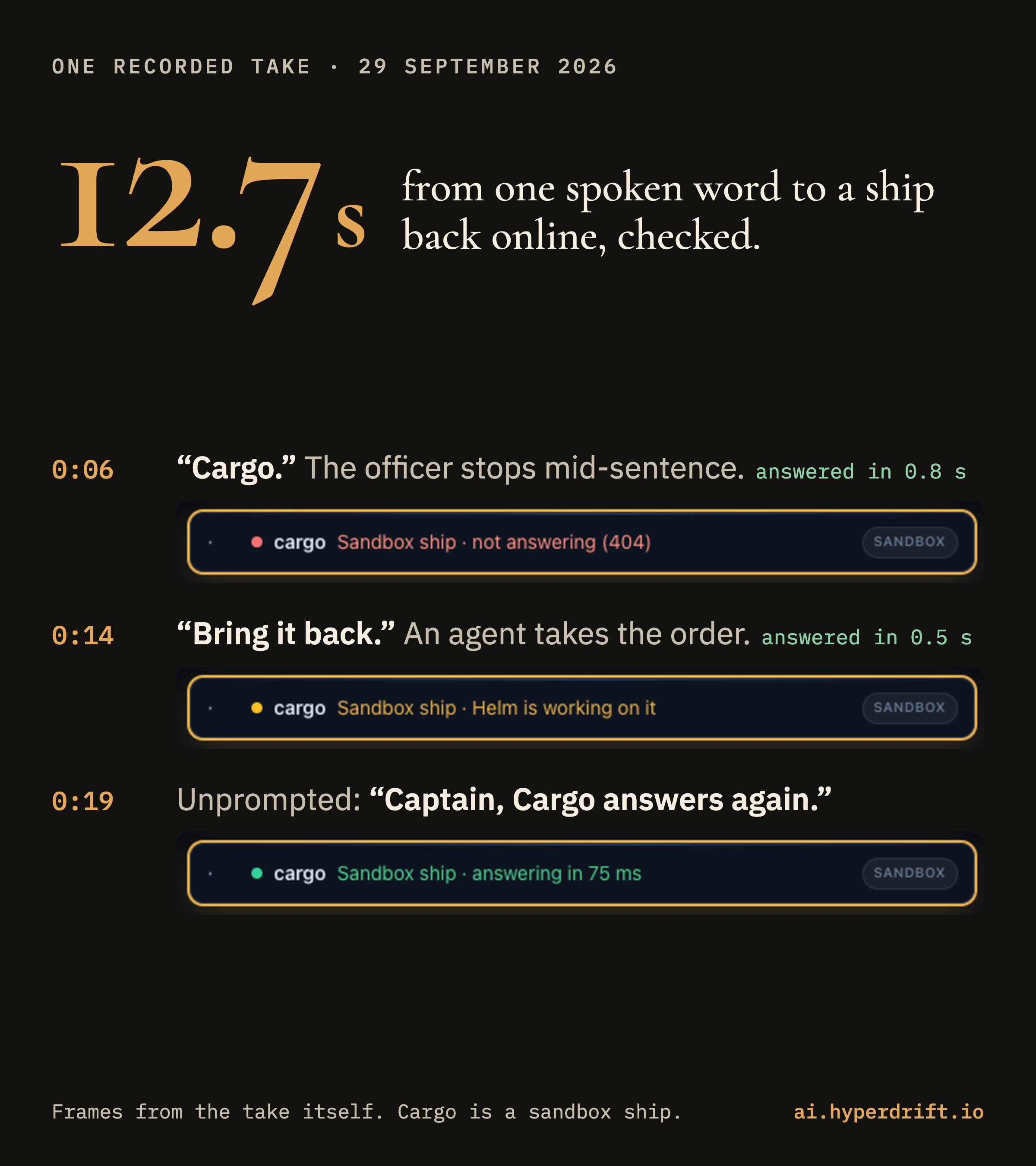
The officer is mid-sentence when you say one word: "Cargo". It stops, and tells you the ship is down. You say "bring it back". An agent restores it. The officer checks the ship twice from outside, then tells you, without being asked.
You never touch the screen. But the screen never stops following you: the ship you named comes forward, the rest step back, and every choice the officer offers appears as a button, for whoever is looking over your shoulder.
Half a second
Two people talking leave about a fifth of a second between turns. The officer answers in six tenths. A dashboard never answers at all.
That pace took three decisions. The listening model hears you and calls the end of your turn on its own; the one we use was released the day we recorded, trained on real conversations with voice agents, where people say "yes", "why" and "Cargo" and expect to be understood. The officer is its own model: it decides every line before anyone asks a large model to think. And the voice is rented from the same platform, so the words are spoken the moment they are decided.
There was one wall. A voice that has started a sentence cannot be stopped. So when you talk over the officer, it does what a person does: it goes quiet, hangs up on itself, and picks up a fresh line while you are still speaking. You hear a pause of about a second. Underneath, a whole session ended and another began.
Rent the voice, own the judgement
AssemblyAI hears and speaks. That half is bought, and it should be; nobody should build their own ears.
What the officer says is ours. Every line comes from a decision already written down with its evidence: what the agenda holds, why each item is on it, what an order means. Nothing is improvised about your business at two seconds' notice, and nothing is invented. When the officer says the ship answers again, it has checked.
So build in that order. Write the decisions down first, with their evidence. The voice comes after, and it is the easy part.
Who it leaves out
A voice is not the door for everyone. If you cannot hear, or cannot speak, or work in a room where talking is not an option, the officer is only useful because everything it says is on the screen as well, and because you can type to it. That is not a footnote. An interface that only works for people who resemble its author has not shipped.
The next step is the same idea with less in the way: dictate straight to the tools your apps expose to agents, and let the screen be optional.
Send this to whoever builds your Monday report by hand. Then talk to the officer; the code is open.
Which decision would you rather say than click?